
good talk
keep information flowing—invitation to a Practice Circle / Friday, July 24 @8am PST

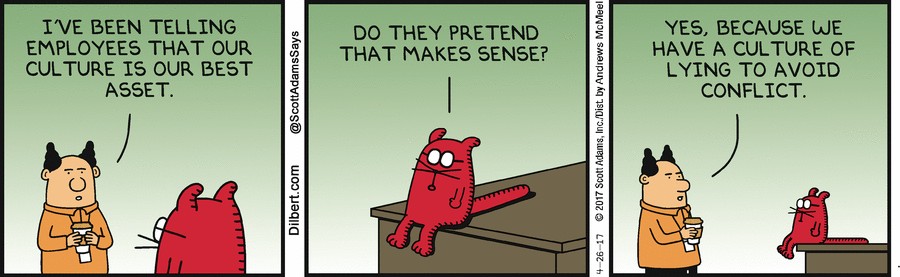
A few years ago, in my family’s nomad season, we found ourselves in Oakland, CA, meeting with a homeowner willing to rent to us on a monthly basis. She was a nice woman, but in our first conversation, she said something that made my Spidey senses tingle. She said she would handle all our transactions uncannily smoothly and efficiently because she was conflict-avoidant.
My immediate thought was, Oh no.
I had this thought because I’ve experienced people who avoid conflict as reliably generating more conflict—and it tends to be conflict that could have been avoided with a fairly simple conversation.
There are myriad, understandable reasons why people—and cultures—become conflict-avoidant, despite its evident downsides. As an inner scientist, facilitator, and plain old human being, I find it instructive when conflict arises and communication breaks down—and inspiring when it comes back together. And I can’t help but notice that, when it comes to conflict or difficult conversations, we have various suboptimal strategies. Many of our more challenging exchanges end up as some version of these:
misunderstanding and undesired outcomes
avoidance, brewing resentment, and passive aggression
emotional repression and eventual explosion
As you know from your lived experience, none of these outcomes feel good in our bodies, hearts, or minds.
What’s interesting from an inner-science point of view is that the ways we engage interpersonally—with others—often mirror the ways we engage intrapersonally—with ourselves.
In other words, we talk (or don’t talk) to ourselves like we talk (or don’t talk) to others. The same parts of us who sense behavior externally and react to it, often detect our own behavior and have the same reaction internally.
A quick example: Not long ago, one of my friends saw a group of people dressed as clowns (yes, clowns) in a public park. Upon seeing them, she vented, “Oh my god, they should take that inside.” When I asked her what she meant, she expressed disdain for what she interpreted as attention-seeking behavior. She quickly realized she had that same reaction toward herself if she perceived herself as too loud or ‘out there.’ The same part of her speaking semi-scathingly externally would express the same sentiment internally, directed at her.
When a communication or interaction doesn’t go well, when it’s not ‘good talk’—inner or outer—I call it closing the channel. I think of the channel as the flow of information between two apparently discrete beings. There are many ways to close the channel, and we tend to be pretty good at them.
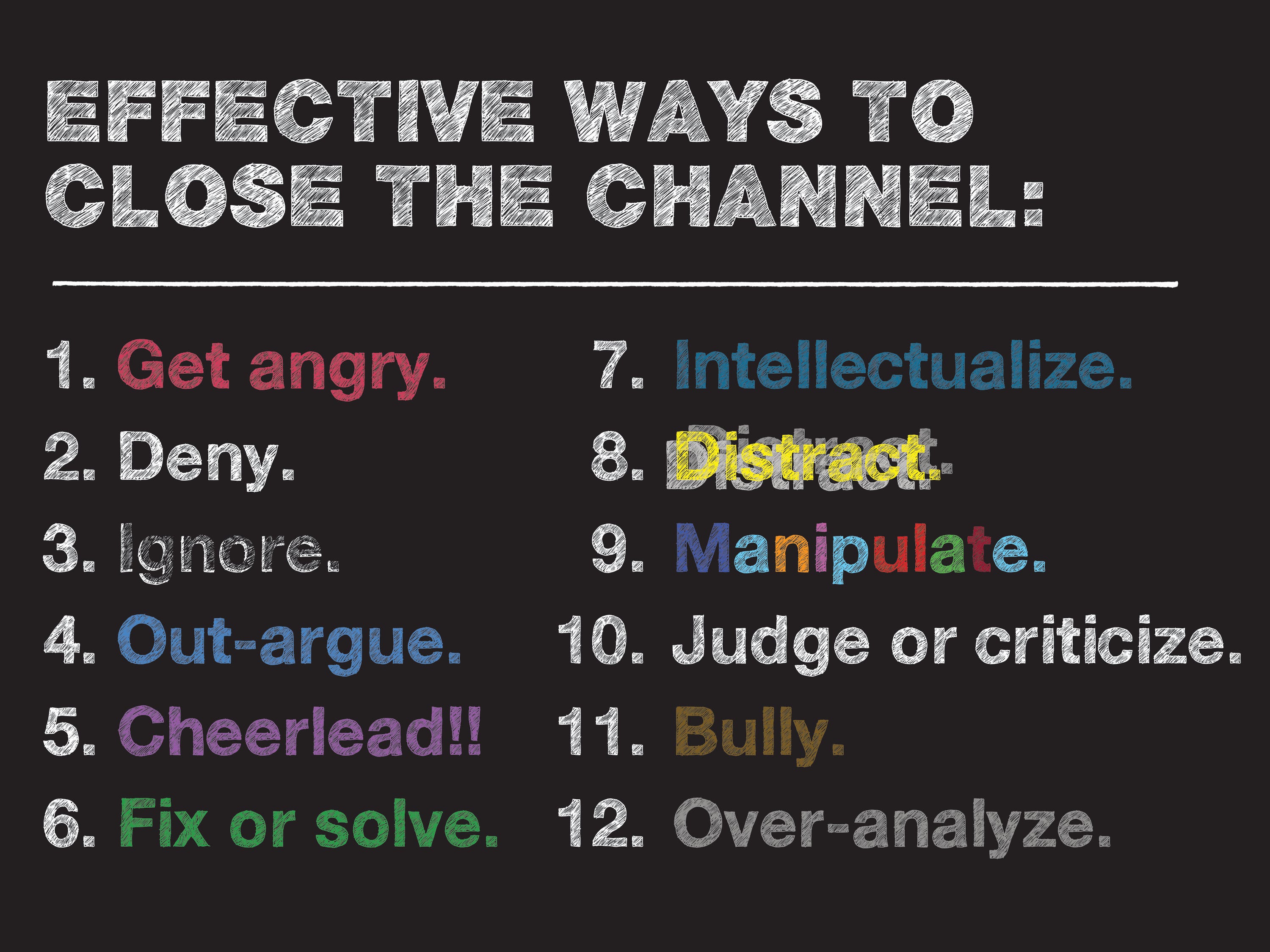
The uplifting news is that we can also open the channel—or reopen it when it closes or collapses. We can reopen a dialogue with a colleague we rudely dismissed, or we can re-engage with a part of our own mind that we previously met with antagonism. I’m not saying opening the channel is easy; I’m saying it is always available and possible when we are sincere.1 In my various roles, I’ve learned time and again that the most potent, effective way to keep the channel open, or to reopen it when it closed, is the following:
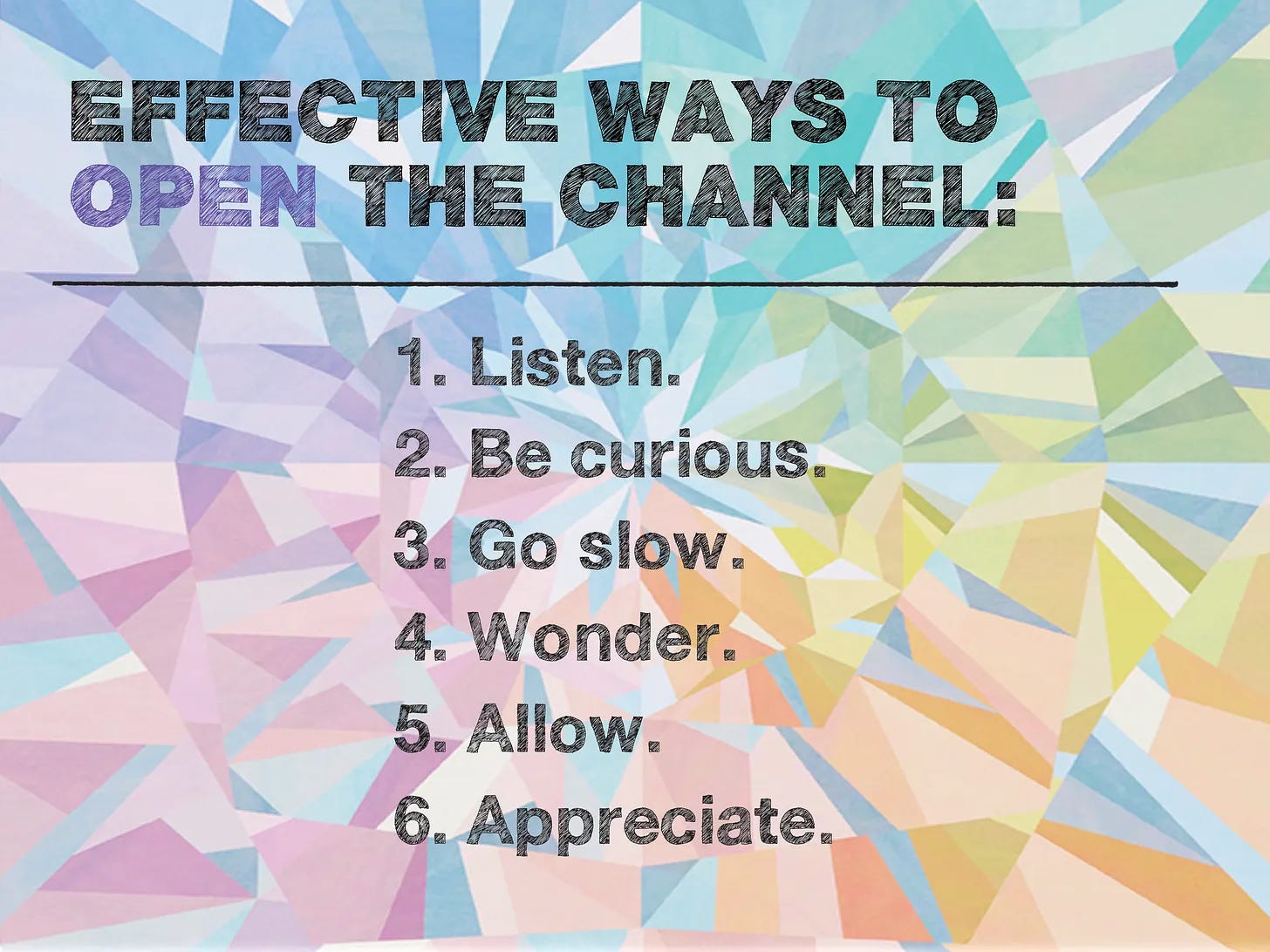
This approach works essentially every time—with human and non-human animals! But I’ve observed with dismay that we are rarely taught to open and sustain these places of warm-hearted curiosity, wonder, not-knowing, nor do we know how to speak from those places. We’re more accustomed to speaking unconsciously from places of criticism, judgment, punishment, pathologizing, and systems of punishment and reward. Even if we find it in our hearts to meet ourselves and others with an expansive view, we struggle to find the words to express that view, to stay in respectful dialogue through the natural frictions of life.
Our next CLEAR Practice Circle is about learning to keep the channel open. Together, we’ll practice one powerful technique to sustain the flow of information—with ourselves or others.
It feels important to add that there is nothing to be ashamed of when our words close the channel. The opportunity is to notice it, forgive ourselves, and find the courage to open it again for relationships we are invested in. This, I assure you, we can do.
For those of you who don’t yet know what a CLEAR Practice Circle is, you can learn more about them below.
working with the inner argument

Recently, I was cooking with a friend and listening to his inner process of experimentation, which was being spoken unselfconsciously out loud. All was well until a sautéing situation went awry and, in the blink of an eye, he went from a judgmental ‘I f*cked this up’ to a deflated ‘This is so disappointing’ to a harsh ‘How could I be such an idiot?’ to …
Until then, I hope you experience a few ‘good talks,’
Sun
There is an assumption here that the other party involved in the communication is at least moderately interested in mutuality and could not reasonably be plotted on the Dark Tetrad. With forms of consciousness that are predatory, extractive, committed to being transgressive—in other words, reliably and predictably unsafe—different wisdom practices apply, at different stages along our own psychological and spiritual formation. As a Zen practitioner, I hold two seemingly paradoxical orientations that challenge me constantly—the first is that in the absolute ground, all beings have Buddha nature, Christ-consciousness, unsullied heart and mind. The second is that, in the relative (the embodied, material realm), the egoic scaffold, the inner constellation, of many people is not aiming for mutual care and is instead aiming for control, power-over, ruthless self-interest, or harm. My framing of opening the channel, therefore, is contingent on the assumption that a somewhat healthy relationship with the other person in the dynamic is possible, and that your goal is to preserve the relationship and/or keep the information channel open, rather than letting either of them fall into disrepair.
Excited to experience some Gamestorming. I am a big fan of Dave Gray and the magical School of the Possible