
boundaries
a game to gift everyone for the holidays

For reasons almost entirely my fault, my dog Kloud has terrible boundaries. He follows me around the house wherever he likes and stares at me intensely for as long as he wants. He licks my hands, my face, the soles of my feet, and investigates any body part that warrants it, according to him. Kloud steps on my toes, boops my cheeks, puts his paws on my face. He shoves his nose into my slippers, shoes, purse, my jacket pockets. If I attempt to bring a new object or person into the house, he/she/they/it will not get through the door without Kloud’s inspection.

Kloud has three-feet-long legs and weighs over 100 pounds, but he regularly boulders on top of me and plops down with a sigh. He blocks my view of the television, knocks the book I’m reading out of my hand. He forces me to put down my tea, lest I scald us both, and he hovers his face precariously close to whatever I’m imbibing—wine, cereal, pasta, soup. Kloud wantonly shoves his nose into the crack of my ass and circles around to look me in the eye and affirm this action. He waltzes into the bathroom when I’m bathing, peeing, shaving, or flossing, in order to sniff the happenings, evaluate the situation, and stand at attention for me to massage him. Kloud regularly barks or cries at three in the morning because he’s bored, or needs to pee, or he wants to make sure we’ve been notified of the hooligan street cat outside.
When Kloud was smaller and a ball of pure energy, the day came when I ran out of ways to entertain him. But I noticed he enjoyed shredding cardboard boxes and I decided that, since we had reams of paper!, I could get work done and simultaneously burn off his energy by letting him tear sheets of paper into bits. Because of this poor decision, Kloud has since destroyed a meticulously-curated handwritten guest list for my father’s funeral, a vehicle registration sticker that comes only by mail, and—just yesterday—$60 in cash.
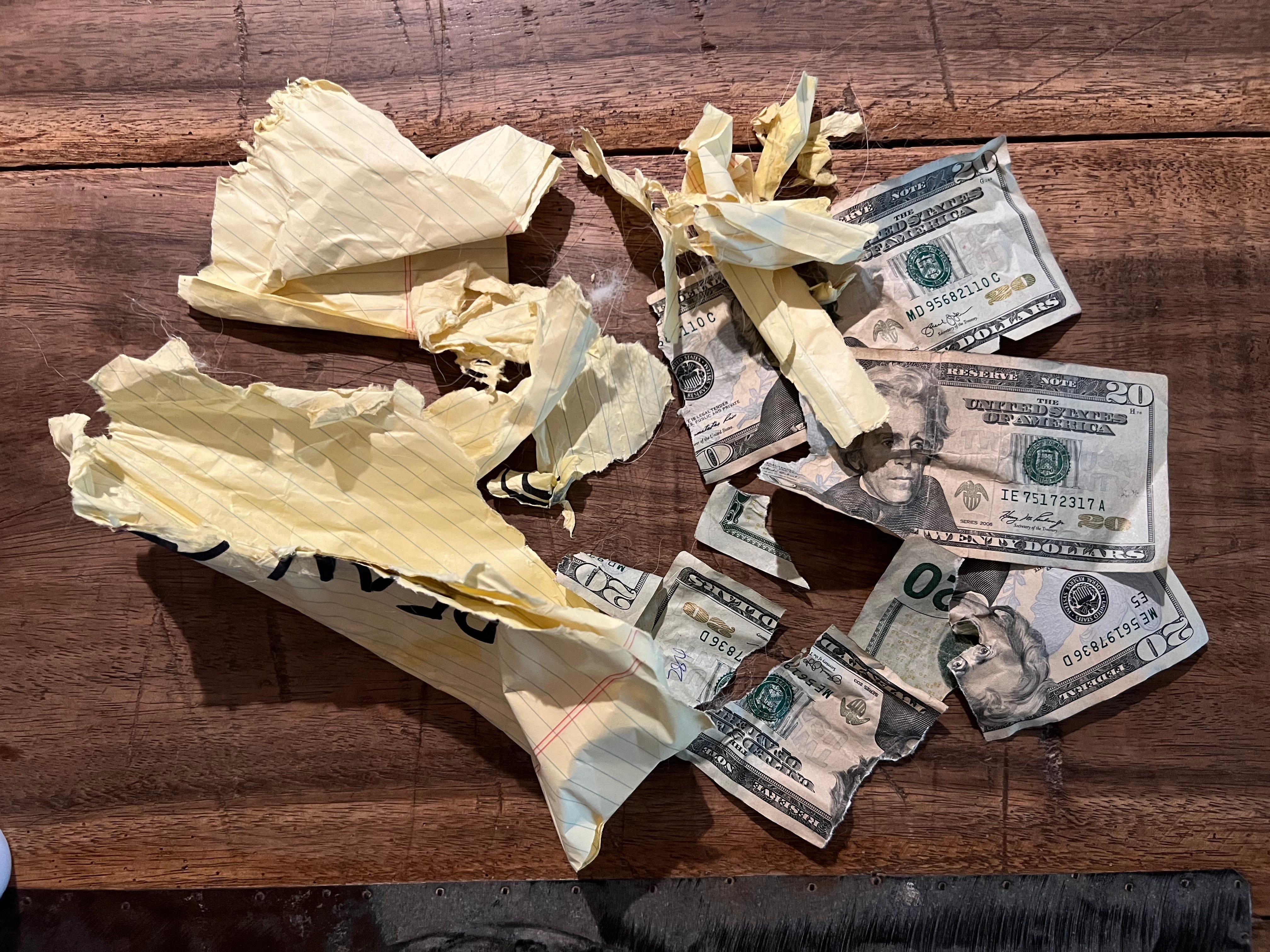
In perhaps any universe, it could be said that Kloud has no boundaries—or precious few—and this is my imagining of how he feels about that.

Because I love Kloud with a ferocity that borders on intrusive, it is rare that I mind his trouncing of my personal boundaries. Chet and I have trained many dogs to be Good Citizens, so Kloud is not free to be a menace to society or a nuisance to guests, but he can splay his unselfconscious zest for life willy-nilly around me and I consider it part of our exuberant relationship.
Contrast my expansive view of Kloud’s relational carte blanche with the more complex exchanges that happen in human relationship. Just in the last few days:
> > > a colleague requested a favor right on the edge of uncomfortable, inspired by my untempered enthusiasm;
> > > I got a request via text to make myself available (in the next few hours!) so that my brain could be picked;
> > > I sent an email to a Zen teacher inquiring about the practice edges of my new binji role;
> > > a friend’s mother told my friend to tell me when I should be at the airport so I’ll have time to do what she felt I needed to do.
In each of these instances, suffice it to say, Kloud’s carte blanche boundary-smashing was not the default. These folks and I don’t have the same high-trust, goofy, intimate understanding that Kloud and I share, so each instance requires a pause, a discernment, and an approach toward a boundary—sometimes on both sides of the equation. Each exchange requires a multi-step process that leads a human duo toward a unique result.
That result might look like the onset of a frank negotiation, the choice to ignore a request (and care for the parts of me unnerved by that), or a firm no, without explanation. Whatever the result, all roads lead to at least the exploration of a boundary, and all sentient beings1—even those strip-mined of dignity from day one—retain a basic need for self-preservation, respect, agency, and sovereignty. The negotiation of those drives is where friction comes in, often in the form of needing to set and enforce boundaries—or fail to and deal with the consequences.
There are clinical ways to describe a boundary but, in anticipation of the holiday season—famous for stressing people out—I wanted to share a simple way I think of a boundary when I find myself facing the need to set one:
A boundary is how I choose to not abandon any part of myself in the process of relating to or exchanging with you.
If that’s not elegant enough, let me call in a now-classic Internet quote from therapist and author Prentis Hemphill: Boundaries are the distance at which I can love both you and me simultaneously.
Setting a new boundary may initially feel anxiety-provoking to our mammal bodies—how will both parties react?!—but a boundary is an act of preserving a relationship, rather than creating the conditions for its eventual demise. I’m not an expert in the sociocultural nuances or neurobiology of boundaries, nor do I exhibit mastery over their application. But I can say with confidence that when two people attempt to know their healthy restraints and communicate those restraints without alienating each other, we have given ourselves a significantly better shot at staying connected.2
If you sit with that idea, it becomes intuitively obvious. We all know from a thousand tiny cuts3 that the absence of clear boundaries elicits painful emotions—not liberating ones—and they’re emotions we know all too well: self-doubt, disappointment, longing, resentment, sadness, bitterness, rage. When a relationship elicits those painful emotions often enough, we don’t want to stay connected.
The tragedy of holiday merry-making is that many of us feel socially obligated to permit and cause harm to ourselves—great and small—to experience the alleged “joy” of being together. Family members are often the worst boundary-offenders, believing that blood is thicker than water4 and they have a right to run you over with impunity. Perhaps you have a healthy family culture and, if so, more power to you. Still, odds are that, at some point, with some person in your tribe, there will be a relational violation—some transgression, subtle or overt, of your sense of being respected or autonomous. You may ignore this violation because your culture demands it, or because it happens so often you’re numb to it, or because some part of you thinks you deserve it, or you may shrug it off because it genuinely didn’t bother you. But when it’s a true relational violation, your mammal body will sense it, feel it, and know it. You can override this physiological feedback with an over-developed intellect, a quick rationalization, or a snippy clapback, but the emotional charge will linger in your body, looking for an exit.
It does not matter what marketers jingle, the holidays are potential landmines for hurt feelings.
Call me a humbug, but I’m embodying the anti-Scrooge since I’m about to offer a game to make the holidays feel good—or at least better—which is allegedly what they’re about. For Gamestormers, there’s always a game for that. :)
GAME: YOUR BOUNDARY IMAGE
OBJECT OF THE GAME: The goal of this game5 is to use an image to help you build and reinforce an inner (psychological) boundary that helps you keep out (a) what is not true for you and (b) what is not about you. You can use this image repeatedly over the holidays to buffer you from untrue / inaccurate and impersonal / third-party statements that can cause you unnecessary distress or harm. This game is about visualization and discernment. It activates:
the primary visual cortex,6 which helps us process, imagine, and make sense of visual information (90% of which comes from the content in your brain rather than your eyes)
the mentalization neural network, which helps differentiate your mind from another person’s mind, discerning what is and is not true for you
CONTEXT: a holiday meal, outing, or gathering with your family
HOW TO PLAY AND PRACTICE: A boundary image is an image you can use over the holidays (and beyond) to gently prevent yourself from absorbing information that does not belong in your awareness or in your emotional field. To use your boundary image, you must first find your boundary image. To do that, you’ll need to slow down, close your eyes, turn your awareness inward, and make this request of your visual imagination:
<Quietly asking your Inner World> “When I’m in a social situation and I’m hearing something that is BOTH not true for me AND not about me, show me an image that represents that reality.”
You are requesting an image from your heart and mind that visually represents the simultaneous presence of these two conditions. Let the image come when it comes. Just hold the question.
Whatever image you receive—and there’s no need to have a preference—that image will be the signal, the shortcut, the heuristic, the sign for you to not absorb the information you’re hearing because it is information about the other person, it has nothing to do with you and, therefore, you do not need to take it in. Your brain will learn to actively use your boundary image to sweep that information from your field. You can conjure this image if and when a family member is issuing passive-aggressive, sarcastic, antagonistic, teasing, diminishing, or inaccurate statements.
The brain is muscular in its own way, so if you embed this image in your inner ground through recurring use, it will become more effective. The boundary image can be simple or elaborate—flowing water, a lotus flower, the face of your fun-loving dog—whatever your incredible brain offers. Below is what surfaced for me.
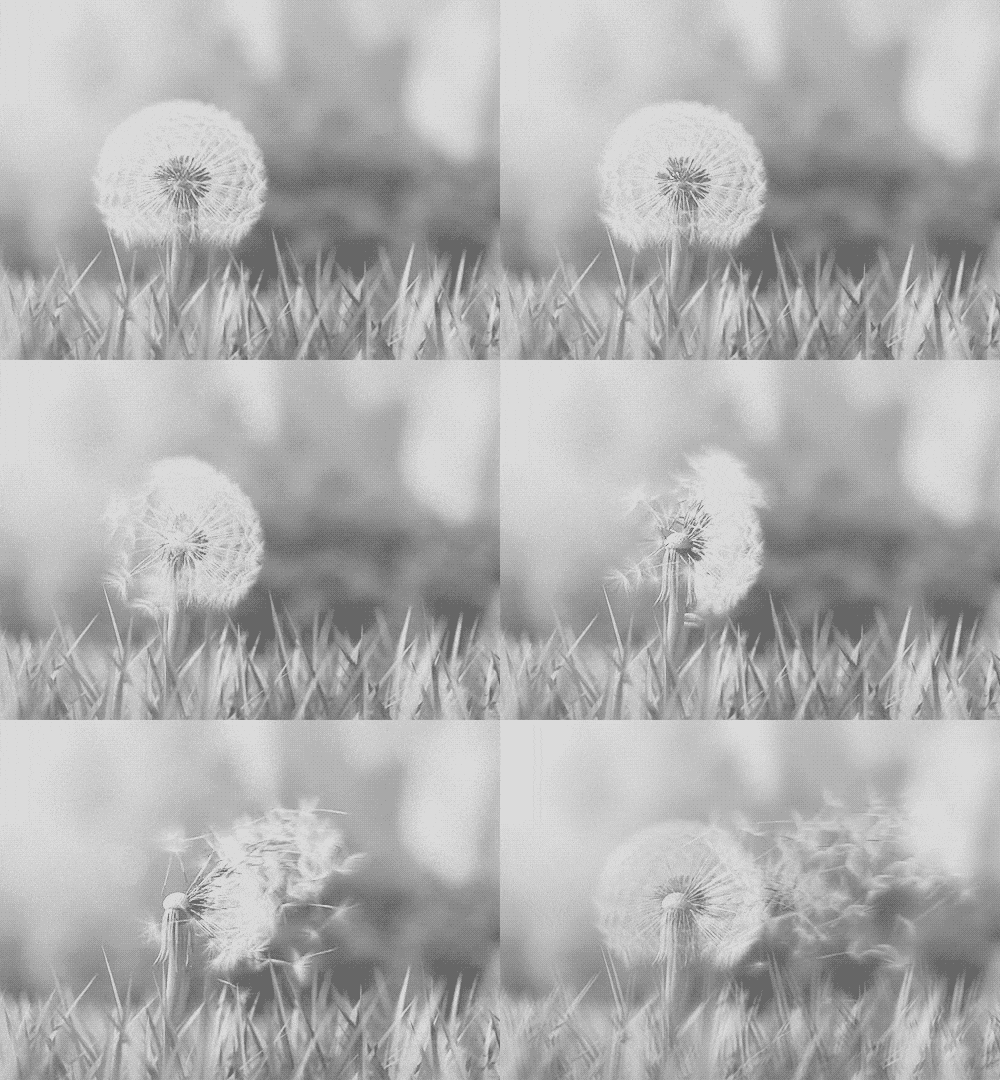
Much of the time, holidays with family are pleasurable—but not all of the time. Since we have the power to resource ourselves, we may as well use it. Play one game that is small but mighty. And if the idea of practicing a psychological boundary causes you distress, keep this in mind: There are four general boundary types7 and for this type, no one but you needs to know it’s there. You can generate inner peace without exposure or interference. This may be your greatest gift for the holidays—one ultimately in service to all.
Love,
Sun
Human, animal, vegetable, mineral . . . it’s wiser to not underestimate the sentience of life’s diverse arrays.
A note of exception for people who can reasonably be plotted on the Dark Tetrad across sociocultural and situational contexts. My framing of a boundary in this post is contingent on two assumptions: the first that a somewhat healthy relationship with the other person in the dynamic is actually possible, and the second that your goal is to preserve the relationship rather than letting it wither. With forms of consciousness that are predatory, extractive, committed to being transgressive—in other words, reliable and predictably unsafe—different wisdom practices apply, at different stages along our own psychological and spiritual formation.
Like feedback unsolicited but brazenly given, ill-informed opinions issued about who we are, passive aggressions in the “spirit” of corporate competition—the list goes exhaustively on and on.
This proverb (of note: it was not biblical) has a long and storied history, with the meaning turning into its opposite repeatedly over time. Some variations refer to blood covenants or blood oaths among warriors, or bloodshed in battle, as experiences that make those blood bonds stronger than kinship (the water of the womb). Other variations refer to the opposite—that kinship and biological ties outweigh loyalty to others.
This game is an adaption of an activity from Setting Boundaries that Stick by Juliane Taylor Shore, LMFT.
The primary visual cortex is the part of the cerebral cortex that processes, imagines, and makes sense of visual information. One of the things I love about the primary visual cortex is that it draws most of what it sees from your brain and your mind, not from your eyes. In other words, we “see” what we “believe,” not the other way around.
External, Psychological, Containing, and Physical, from Setting Boundaries that Stick by Juliane Taylor Shore, LMFT.
Love this perspective. I’m working my with a leader on boundary setting as we speak. Their problem is based in a desire to keep her people happy and expressed by not turning anyone away even if it’s eating their calendar. But they’re learning that an “open door policy” doesn’t mean that the door is flood gates, rather that it’s a mindset that still can have structure and clarity (ie 15 min mtgs, bringing solutions, etc). I’ll be writing more about this soon.